
Moore County Release Meanings
A release record answers when the Moore County Detention Center stopped holding a person, why custody ended, and whether another agency received that person. It is narrower than the live roster and more useful after a name disappears. A person may leave on bond while a criminal case remains open. Another person may finish a local sentence, receive credit for time served, or leave after a dismissal or court order. Someone committed to the North Carolina Department of Adult Correction, transferred to another county, picked up by the U.S. Marshals Service, or moved to immigration custody has left the Moore jail without entering the community.
The Moore County Sheriff's Office is the local custodian of the jail record. The court keeps the legal case and its orders. NCDAC keeps a separate state correctional history, while NC SAVAN supplies custody-event notices from participating county and state sources. Each record has a limit. A bond entry is not proof that the person crossed the jail exit. A roster absence does not name the destination. An alert can report a change from one custodian without proving full sentence discharge.
| Release label | What it means | Best next record |
|---|---|---|
| Bond or court order | County detention ends while the case may continue. | Jail exit record plus the Moore court case |
| Time served or sentence end | The stated local term is complete or credited. | Judgment and entry-and-release summary |
| Parole or post-release supervision | Prison custody ends, but legal supervision continues. | NCDAC release and supervision history |
| Transfer | Custody moves to another jail, prison, USMS, or ICE. | Receiving-agency locator and transfer field |
| Dismissal | A court charge ends, but the jail record confirms exit time. | Court disposition plus jail release record |
Note: “Released” means release from the named custodian, not always freedom from every form of custody or supervision.
Moore County Release Record Fields
Ask for an existing entry-and-release summary, booking sheet, incarceration record, or commitment and release order. Moore County does not promise that every requested field exists in every booking. A focused request identifies the person and asks for the fields already held rather than demanding a custom list. The booking number helps distinguish people with similar names. The release date and time establish the physical custody event. A release type, authority, order, or destination can show whether the event was a community return or a handoff.
| Field | What it can show |
|---|---|
| Full name and identifying data | The person tied to the Moore booking |
| Booking number | The local custody episode linked to the record |
| Admit date and time | When detention began for that booking |
| Release date and time | When Moore custody ended |
| Release type or reason | Bond, sentence completion, transfer, or another recorded basis |
| Releasing authority or order | The court or official authority behind the change |
| Destination or receiving agency | Whether another custodian took control |
| Charge and bond references | The case and bond data tied to the booking |
North Carolina's sheriff retention schedule treats website display and agency retention as different questions. Entry-and-release summaries, arrest sheets, release orders, work-release material, and pretrial-release agreements fall within the inmate incarceration record category. The schedule authorizes destruction three years after release or transfer, subject to other holds. A weekly inmate list may be destroyed when superseded. A Moore name can therefore leave the website well before the underlying record reaches its scheduled disposition point.
Request Moore County Release Records
No dedicated online Moore Sheriff release-record form, fixed response time, or fixed release-record fee was found. Start with the Moore County Sheriff's Office and ask where to send a written request. The office lists 302 South McNeill Street, P.O. Box 40, Carthage, NC 28327, telephone 910-947-2931, and weekday hours from 8 a.m. to 5 p.m. The detention line is 910-947-2980. Keep the submission and response because the request itself helps show the exact record sought.
- Identify the person by full name and, when known, date of birth or booking number. Add an approximate custody date range.
- Ask for the existing entry-and-release summary and booking record, including admit and release times, release reason, authority, and destination if recorded.
- Request an electronic uncertified copy. Ask for a cost estimate before unusually extensive work begins.
- If part is withheld, ask for the statutory basis and the segregable public remainder. Do not ask the agency to create a new report.
- Compare the response with the Moore court docket or the receiving agency's record when the disposition is unclear.
G.S. 132-6 provides for inspection at reasonable times and copies as promptly as possible. G.S. 132-6.2 generally limits ordinary uncertified copy charges to actual reproduction cost, permits a reasonable special service charge for unusually extensive work, and does not require an agency to create a record it lacks. Moore County has not published a special release-record price in the reviewed sources.
A precise request asks for existing fields. It does not assume a release reason, a community destination, or a booking photo is public.
Moore Release Law and Expunction
Chapter 132 broadly covers documentary materials made or received in North Carolina public business, including electronic records and photographs. That broad rule has specific limits. G.S. 132-1.4 generally excludes criminal investigation and intelligence material from ordinary public access while identifying certain basic arrest or incident data that may be public. A custodian can redact protected parts. The requester may still ask for the nonconfidential release fields that can be separated.
Expunction is a court process, not proof that custody never occurred. The North Carolina Courts expunction guidance explains that eligibility depends on the result, offense, dates, and other conditions. Some routes require the full sentence, probation, parole, or post-release supervision to end first. The guide lists a general filing fee with statutory exceptions and warns that the process may take months. An order can affect state public records, but it does not automatically erase a private copy or every federal or immigration record.
Juvenile records, sealed matters, protected victim data, and investigative material require separate treatment. The safest practice is to preserve the signed order and work through the Moore clerk if court-system data remains. A person seeking legal advice about eligibility should consult a qualified attorney. The release record itself remains a record of what the custodian did, subject to the access and expunction rules that apply to that exact record.
Note: A public-record definition does not override a specific confidentiality law, and an expunction does not rewrite every independent database.
Find Moore County Released Inmates
Begin with the last known custodian. The official Moore detention portal can establish a current or recent booking context, but it is not a verified release archive. Search the name, charge, or available current-inmate view. If the person appears, the record supports custody at that update. If the name is gone, do not stop. Record the identity and booking clues, call the jail, request the release summary, and then follow the destination.
- Check the Moore portal for current presence and note the name, admit date, and individual record link that actually appears.
- Ask detention whether the person remains there. Request the entry-and-release summary when custody ended.
- Search the Moore court case for bond, dismissal, judgment, sentence, or release-order entries.
- Use NCDAC for a state commitment or state supervision, not as proof of a purely local jail release.
- Check NC SAVAN for an event, then verify it with the named source agency.
- Use BOP, ICE, or the federal docket only when a federal or immigration path is supported.
A person who leaves the current roster may have transferred. Absence alone does not prove a community release or identify an exit date.
For a same-day group view, Moore has no verified public release feed. Use Released Last 24 Hours for the local fallback without converting a booking search into a release list. For one named person, combine the jail, records request, court, state, and federal channels.
Moore State Release Search
The NCDAC Offender Public Information Search covers state prisoners, probationers, parolees, and inactive records back to 1972. It does not supply Moore County jail history. Select All when a person may still be under community supervision. Select Inactive when looking for someone no longer active as an NCDAC inmate or supervisee. An offender number is the best identifier when names match. Open the individual result and compare identity, incarceration history, release entries, conviction and sentence data, and the current public supervision status.
| Search field | How to use it |
|---|---|
| Status | All, Active Inmate, Active Probationer/Parolee, or Inactive |
| Name | Last, first, middle initial, with a sounds-like option |
| Offender number | Separates people with similar names |
| Identity filters | Gender, race, ethnic group, and birth date tolerance |
| Age range | Narrows broad name results |
NCDAC also provides a distinct Inmate Releases search. It can search by release county, year, month, or a last or partial last name. Moore appears as a release-county choice. That field is a state correctional record dimension or destination. It is not a list of people released from the Moore County Detention Center.
The official state release form shows why the systems must stay separate. A person returning to Moore after state prison can appear in a Moore release-county search even when the sheriff did not release that person.
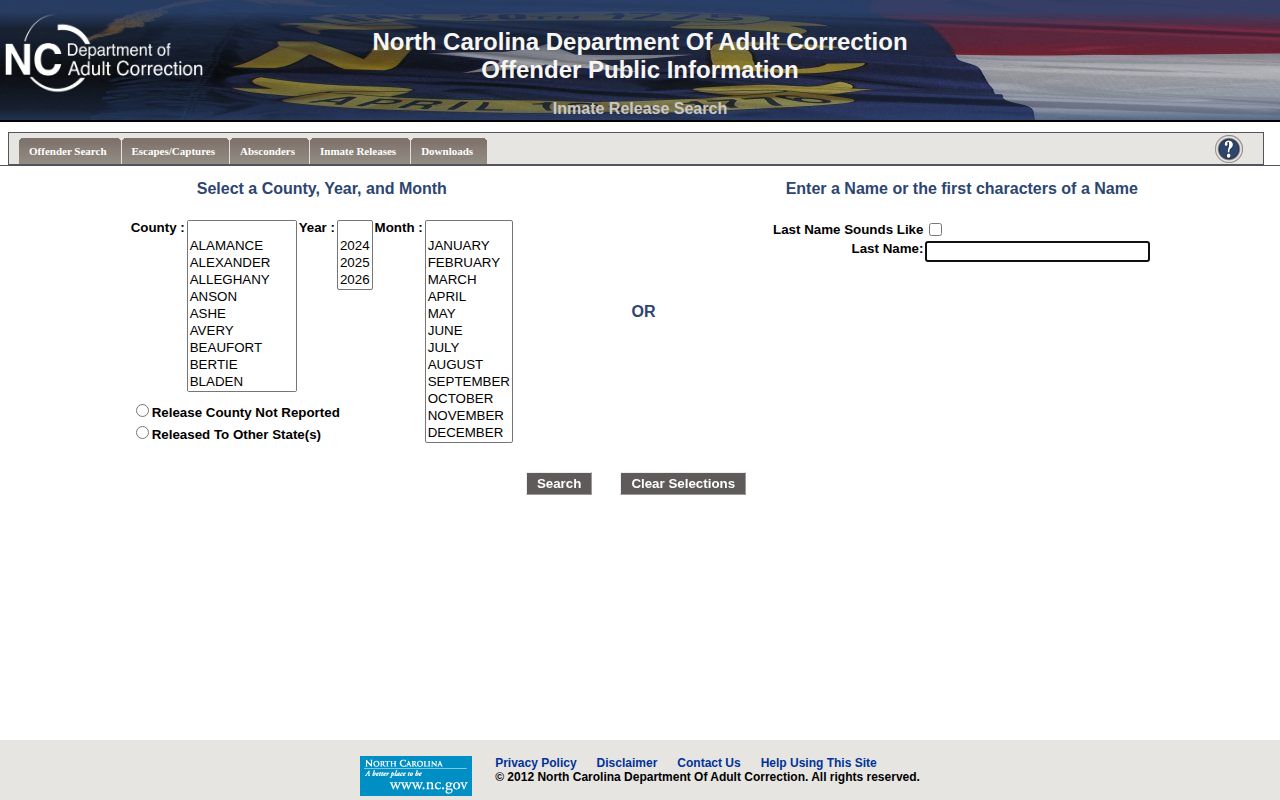
The form is the strongest online group search for NCDAC releases, while a local jail exit still requires the sheriff and court path.
Moore Released or Still Held
Each system answers a different custody question. The current Moore grid is a snapshot of jail custody. The sheriff's release record is the local documentary history. NCDAC covers state incarceration and supervision. NC SAVAN reports custody events from participating sources. BOP and ICE apply only to their own federal systems. A single search cannot replace all of them.
| Source | Still in custody | After release or transfer |
|---|---|---|
| Moore jail portal | Current name and admit data may appear. | Absence gives no verified reason or destination. |
| Sheriff release record | Shows the booking tied to custody. | Can show exit time, reason, authority, and destination if recorded. |
| NCDAC search | Active Inmate can support state custody. | Inactive or Active Probationer/Parolee must be read with release history. |
| NC SAVAN | Status and source agency may be shown. | An event may show release, transfer, or release with supervision. |
| BOP or ICE | Applies only to that federal custodian. | Past BOP release or recent ICE release has system-specific limits. |
- Discharge
- The sentence or supervision obligation ends under the governing record.
- Parole
- Conditional community release for an eligible sentence under Commission authority.
- Probation
- Court-ordered community supervision that may occur without a prison release.
- Detainer
- A request or legal basis for another agency to take or keep custody.
- Time served
- A judgment or credit treats the required custody term as completed.
Moore Bond Release App Limits
The official Moore Sheriff app can help locate current intake and bond-related information. Local reporting says its detention section includes current inmate or intake material and information useful in a bond-out process. That can identify a booking and help a family ask the next question. It does not show that bond was posted, accepted, and followed by a physical exit.
The official app listing emphasizes public-safety news, outreach, reports, and tips. Neither the store description nor the local report documents a recent-release archive, a 24-hour window, a 72-hour window, or a final release-date field. Use the app as current-booking navigation. Confirm a Moore release through detention, the entry-and-release record, and the court case.
Moore Release Proof in eCourts
Moore County joined eCourts in October 2024. That makes the Moore court location and Portal route a durable path after a short jail stay falls off the current roster. Search by defendant name or case number online where available, use a public terminal at a clerk's office, or ask the clerk for the paper file in the county where the case was heard.
Look for the charge, bond entry, release order, dismissal, plea, judgment, active or suspended sentence, probation, and sentence-completion entries that exist. Those items explain legal authority. They do not always give the physical time the person walked out. Pair the court event with the sheriff release record. A state-prison commitment sends the search to NCDAC, while a bond order may return the person to the community with the criminal case still open.
The Moore County Courts Facility is at 102 Monroe Street in Carthage and lists weekday hours from 8 a.m. to 5 p.m. The court record and sheriff record should agree on the identity and custody episode even when they answer different parts of the question.
Note: A court order explains authority for release, while the Moore jail record supplies the actual custody exit time.
Moore Release Alerts and Transfers
North Carolina calls its VINE layer NC SAVAN. Search one person in the NC VINELink interface, compare the source agency, and read the event and date exactly as displayed. County jails and the state prison system both contribute. A state release with supervision is not full discharge, and a county custody change may be followed by a transfer. Register on the correct record if future notice is needed, then confirm the event with the sheriff or NCDAC.
Federal paths are separate. The BOP inmate locator covers federal releases after 1982 and can show a release date and location. A past date with RELEASED or no institution means the person is no longer in BOP custody, not that every form of custody or supervision ended. ICE's locator can cover current ICE custody and releases from ICE custody within its stated recent window. The U.S. Marshals Service has no public released-person locator, so a federal docket, USMS records route, or later BOP record may be needed.
The special NC SBI registry applies only to qualifying registration duties. Its address, picture, offense, and registration status can support a post-release public presence, but it is not a general Moore release list and does not establish the jail exit time.
Moore Post-Release Reporting Center
The Moore County Day Reporting Center adds a local supervision layer. It has operated since 1994 as a referral-based alternative-to-incarceration and accountability resource for people on supervised probation. The county describes cognitive programming, substance-use services, education, and other support. The FY2026 county budget reports 75 referred offenders served in FY2025. That is a program count, not a jail release count.
The center is not an inmate locator and does not accept every person who leaves the Moore jail. A court or supervising authority must make the referral. Its public contact is 107 North McNeil Street in Carthage, 910-947-1549, with weekday hours from 8 a.m. to 5 p.m. Verify public supervision first through the NCDAC record and route office questions through Community Supervision District 19B. Traditional parole, post-release supervision, and probation are not interchangeable.
Moore Release Rides Need Planning
Moore Transportation Services is nearby in Carthage, but it does not advertise a jail-gate release shuttle. Its A-Pines fixed route is suspended. Demand-response trips have stated trip purposes and scheduling requirements, so the existence of a county transport office should not be treated as a same-day ride promise.
The county transportation office lists 910-947-3389. Call in advance about eligibility and scheduling, and separately ask detention where an approved pickup may occur. The facility has not published a family waiting point, physical release exit, or same-day transportation rule. Planning must rest on confirmed arrangements, not a generic assumption about buses or rideshare access.
Moore County Release Facility
The official facility sweep found one locally operated detention facility: the Moore County Detention Center, also described in county material as part of the Rick Rhyne Public Safety Facility. The Moore County Sheriff's Office operates it. Municipal police may make arrests, but the county detention portal is the identified local custodial search.
A person can return to the community on bond, court order, time served, or sentence completion. The person may instead move to NCDAC, another jail, USMS, or ICE. Follow the Moore release record first, then the court or receiving system. No state prison, federal prison, ICE contract detention site, regional jail, or separately searchable municipal lockup was identified in Moore County by the official source sweep.