
Moore County Parole and Probation Differences
North Carolina uses several forms of community supervision, and the words are not interchangeable. Probation generally comes from a court judgment. It can begin without a release from state prison. Traditional parole is discretionary release for eligible sentences, mainly older sentences tied to offenses committed before October 1, 1994, plus narrow exceptions. Post-release supervision is the community portion that follows prison for covered felonies under Structured Sentencing. A person living in Moore County may therefore be supervised even when no recent Moore County Detention Center release exists.
The North Carolina Department of Adult Correction, or NCDAC, manages public offender information and community supervision. The North Carolina Post-Release Supervision and Parole Commission sets post-release conditions and handles eligible parole matters. Neither parole nor probation means that someone is still confined. Neither means unconditional freedom simply because the person is outside a prison.
| Status | How it starts | Best public check |
|---|---|---|
| Probation | A court judgment, sometimes with no prison term | NCDAC offender search and the court case |
| Traditional parole | Commission action in an eligible case | NCDAC record and Commission material |
| Post-release supervision | The supervised part of a covered state prison sentence | NCDAC status and release history |
| Discharge | Completion or lawful end of supervision | NCDAC history or originating agency record |
A county jail bond release is different. If the criminal case remains pending, the Moore court docket and release order may explain the person's obligations better than a parole source. The Moore County released-inmate search and records path covers the county exit record and the court channels used after someone leaves the live roster.
- Parole
- Conditional community release authorized for an eligible sentence.
- Probation
- Court-ordered supervision in the community.
- Post-release supervision
- Supervision that follows confinement for a covered state sentence.
- Discharge
- The recorded end of custody or supervision, depending on the record.
Check Moore County Supervision Status
The NCDAC Offender Public Information Search is the first public source for a person who may be an Active Probationer/Parolee. Search under the broad “All” category when the present status is not known. Names can repeat, so compare the offender number and available identity details. Then read the incarceration and release history beside the current supervision status. Do not join a Moore jail booking to a state record based on a matching name alone.
- Search the person's full name in the NCDAC public search. Use the offender number when it is known.
- Open the most plausible result and compare the identifying data. Reject a result when those details do not fit.
- Read both the present status and the incarceration or release entries. “Active Probationer/Parolee” describes community supervision, not current jail custody.
- For a state prison case, confirm the release entry and supervision status together. For a Moore jail case, also read the court judgment or release order.
- Route office questions through Judicial District 19B. Public staff may disclose only what the law and agency policy allow.
A person still held at Moore County Detention Center belongs in the county's live custody system. A person released from that jail may leave the live roster, while the jail entry-and-release record and court case remain the proof of the exit. A state prisoner appears in NCDAC. Federal custody requires a federal locator. These systems overlap in names, but not in authority.
Community Supervision case files are confidential according to NCDAC. The public status does not promise access to officer notes, a home plan, every condition, or violation details. The search verifies the public status. It is not the full supervision file.
Note: Record the offender number and the displayed status before calling, because those details help separate people who share a name.
Moore County Probation Office Route
Moore County belongs to Community Supervision Judicial District 19B with Montgomery and Randolph counties. The current NCDAC office directory lists the district management office in Asheboro. That district office is the sound contact for routing a Moore County parole or probation question when the assigned office or officer is not clear.
NCDAC Community Supervision, District 19B131-D Dublin Square Road
Asheboro, NC 27203
Phone: 336-318-4228
Fax: 336-626-0318
An older official Moore resource sheet names “Community Corrections - Carthage #1” at 102 Monroe Street in Carthage and gives 910-947-2237. The current statewide directory does not reproduce that field-office entry. Call District 19B to verify the Carthage location before traveling there. This distinction avoids treating an older resource sheet as a current walk-in directory.
The office can route supervision questions, but it is not the Moore jail's release desk. Questions about the physical exit from the detention center go to detention. Questions about a court-imposed probation judgment may also require the Moore court case. Agency staff may confirm only information they can lawfully release.
Moore County Probation Absconder Search
NCDAC provides a separate absconder search that accepts Moore as the county of supervision. An absconder is a person reported as evading supervision. Use that search only after identity has been checked in the general offender record. County of supervision is not always the same as county of arrest, conviction, residence, or present custody.
The official Moore-capable search form shows the route used for this narrow status check.
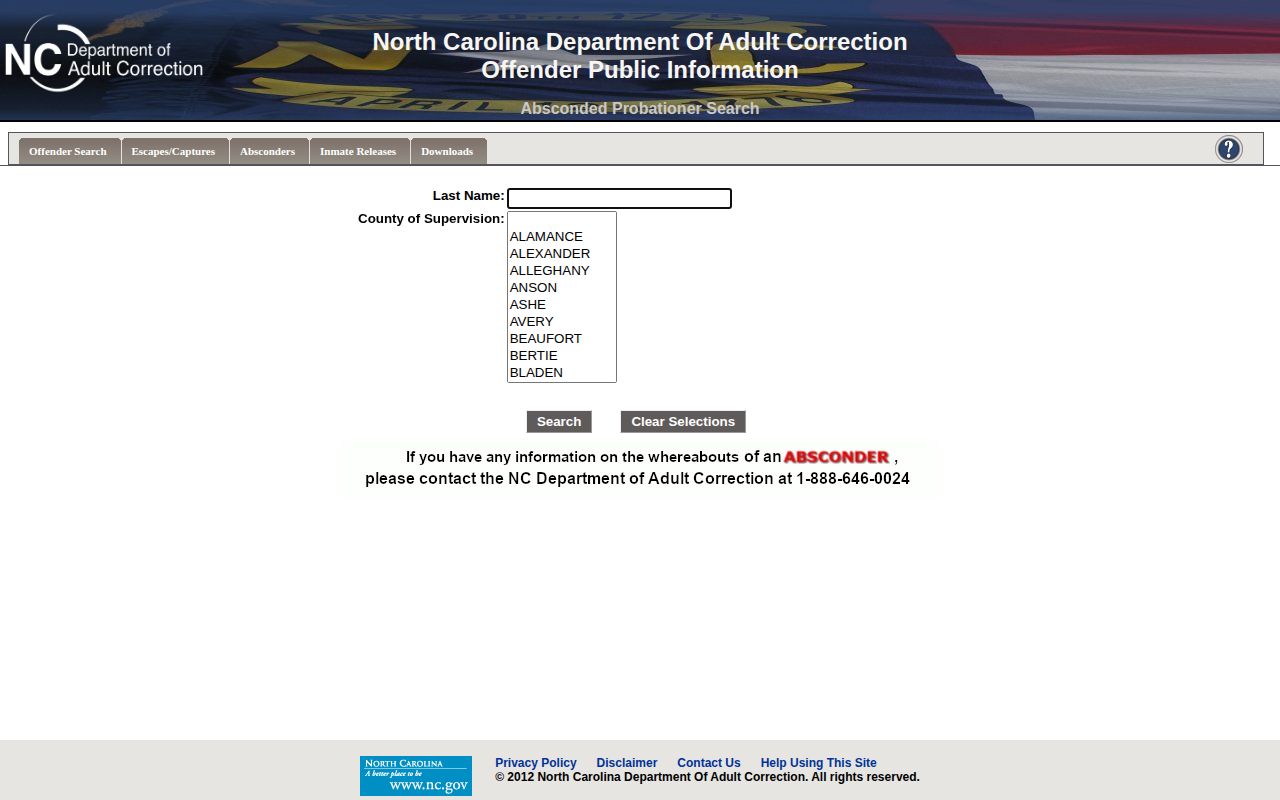
The form can identify a public absconder entry tied to Moore supervision, but the result does not establish a current warrant booking or jail location. A later arrest may appear in a different county custody system. A transfer can also move the person into state or federal custody. Confirm current custody with the agency that now holds the person.
Moore County Probation Day Reporting
The Moore County Day Reporting Center has operated since 1994 as a local, referral-based alternative-to-incarceration and accountability resource. It serves people on supervised probation through education, cognitive programming, substance-use services, and other support. A court or supervision referral controls access. The center is not a public offender locator, a release office, or a place to verify that someone left jail.
County budget material reports that the program served 75 referred offenders in fiscal year 2025. That count measures program service, not Moore County releases, probation starts, or the number of people under supervision. It should not be compared to a jail roster or release list.
Moore County Day Reporting Center107 North McNeil Street
Carthage, NC
Phone: 910-947-1549
Monday through Friday, 8 a.m. to 5 p.m.
The county's own program page is shown below. Its referral role is the key limit for a person seeking Moore County probation help.
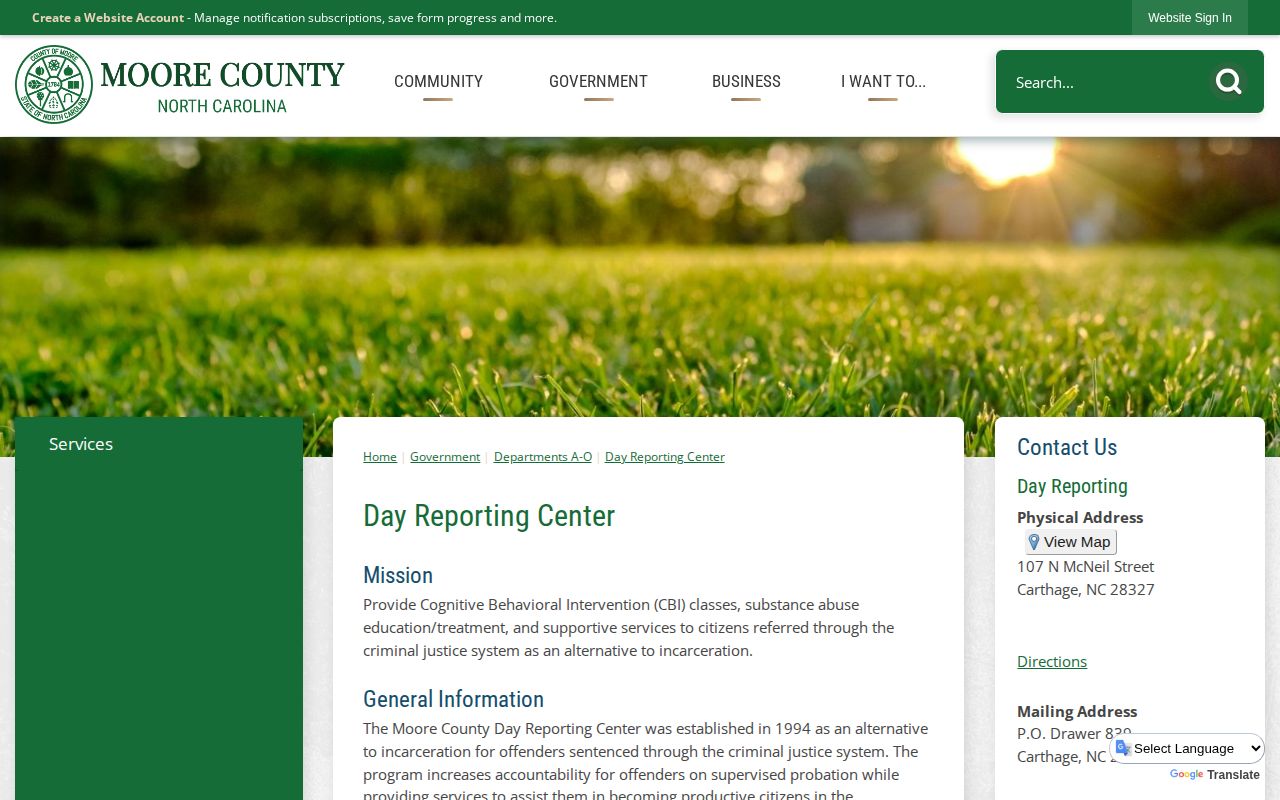
The center may support an existing supervision plan. It does not replace District 19B, NCDAC public status, the Commission, or the court judgment that imposed probation.
Note: Contact the supervising office before relying on the center, because participation depends on an official referral rather than a public walk-in request.
North Carolina Parole Record Review
The North Carolina Post-Release Supervision and Parole Commission expressly says it does not hold formal parole hearings and does not meet personally with offenders during review. There is therefore no ordinary public hearing calendar to consult for a Moore County person. Eligible cases are reviewed on the record. Traditional parole mainly concerns eligible offenses committed before October 1, 1994, while ordinary post-1994 Structured Sentencing ended discretionary parole. Narrow exceptions can apply, and life without parole is never eligible.
The monthly Discretionary Parole Reviews spreadsheets are the public schedule and result substitute. At research time, the series began with September 2024 and ran through June 2026. Published outcomes include Incomplete Decision, Suspend Decision, Regular Parole, Community Service Parole, Early Medical Release, and 90-Day Mandatory Parole. These are monthly case-level publications, not a general person-search portal. Unpublished Commission records remain confidential.
Article 85 contains the legal framework, but a release date or eligibility result should not be calculated from a name alone. Sentence date, offense, credits, minimum and maximum terms, and special rules can change the answer. Use the Commission for an eligible parole matter and NCDAC for the public offender history.
NC Post-Release Supervision and Parole Commission2020 Yonkers Road
4222 Mail Service Center
Raleigh, NC 27699-4222
Phone: 919-716-3010
Email: Parole.Commission@dac.nc.gov
Confirm Moore County Supervision Discharge
Supervision ends through a recorded legal or agency action, not just a move away from Moore County or a missed search result. In a state case, read the NCDAC current status with its admission, release, and supervision history. “Inactive” and a discharge entry carry a different meaning from “Active Probationer/Parolee.” If the public entry is unclear, use the offender number when asking NCDAC or District 19B about the public status.
For court probation, the judgment and later court entries can explain whether the term ended, changed, or led to another order. For traditional parole and post-release supervision, Commission and NCDAC records control their respective roles. A VINELink custody alert may report a move or release event, but it does not replace a supervision discharge record. The Moore County inmate release date information also separates a projected prison date from the actual end of supervision.
Keep the custody question and the supervision question distinct. A person can leave prison with supervision, leave a county jail with a pending case, finish probation without any new custody event, or transfer between agencies. Verify the event with the record owner. That approach gives a defensible Moore County result without assuming that “not in jail” means “off supervision.”