
Moore Release Dates: Projected or Actual
A projected release date is an estimate made before a person leaves custody. North Carolina Department of Adult Correction, or NCDAC, calculates it from the judgment, sentence structure, custody dates, credit rules, and the form of release that applies. The figure can move. An actual release date records an event that has occurred.
That line matters in Moore County. The Moore County Detention Center holds people awaiting court action as well as some sentenced inmates. A pretrial detainee does not have a sentence-based projected date. Bond, dismissal, a release order, transfer, or later judgment can change custody. A sentenced person may have a calculation, but it is not final until the jail records the exit or transfer.
Release also does not always mean freedom from all legal control. A state prisoner may leave confinement for post-release supervision. A Moore jail detainee may move to NCDAC, another jail, federal custody, or immigration custody. Each move ends one custodian's hold without proving release to the community.
Note: A next custody review date is not a parole review date and should not be read as a release promise.
Which Moore Release System Applies
Start with the agency that controls the sentence or hold. The official NCDAC Offender Public Information Search covers North Carolina state prisoners, probationers, and parolees, with current and historical records dating to 1972. It does not provide Moore County jail records. The county's detention portal is framed around inmates and current booking data, not a verified projected-release field.
| Custody situation | Best date source | What to verify |
|---|---|---|
| Pretrial at Moore County Detention Center | Moore court case and detention staff | Bond or court authority, then the physical exit |
| Sentenced in the county jail | Judgment plus the jail's sentence calculation | Authorized local credits and the actual entry-and-release record |
| North Carolina state prisoner | NCDAC individual offender record | Projected date, sentence history, and current status |
| Federal or immigration transfer | The receiving federal system | Which agency took custody and what that agency's date means |
A missing name is not a date. It may reflect a spelling issue, data lag, transfer, or the wrong system. The NCDAC release-county search is also distinct from the Moore jail. Its Moore option concerns a state correctional release dimension or destination, not people released from the county detention center.
Find a Moore Inmate Release Date
Use a name, birth date, offender number, booking identifier, and case number when available. Keep the source and time of each result. That avoids mixing two people or treating an old projection as current.
- Identify the custodian. Check whether the person is in Moore County detention, NCDAC custody, or another system. Do not use a state search to infer a local jail release.
- For NCDAC, search broadly first. Choose All if supervision may still be active. Use Inactive when the person may no longer be an inmate or supervisee. An offender number is the strongest match.
- Open the individual record. Compare identity, incarceration history, sentence data, release history, and supervision status. Record the precise projected-date label and the day it was checked.
- For a Moore jail term, obtain the judgment. Ask detention staff at 910-947-2980 for the sentence calculation or the correct records contact. Compare it with the court's active term and jail credit.
- Check for another hold. A detainer is a request or order that another agency take custody. Ask whether any county, state, federal, or immigration hold changes the destination.
- Confirm close to the date. Recheck with the controlling agency. After exit, request the actual release record rather than relying on the old estimate.
The Moore County Sheriff's Office public contact is 302 South McNeill Street, Carthage, NC 28327. Detention uses 910-947-2980. No local sentence worksheet, public credit ledger, fixed release hour, or weekend-release rule was found in the reviewed county sources, so those details must come from the live record.
For the broader county search and release-record request path, use the Moore County released-inmate search. It helps separate an absence from the live roster from a verified release.
NCDAC Release Date Search Fields
NCDAC's form supports more than a simple name query. The fields help distinguish people and show whether a result is active, supervised in the community, or inactive. The individual record, not the search list alone, supplies the useful sentence and release context.
| Search field | Use | Release-date value |
|---|---|---|
| Status | All, Active Inmate, Active Probationer/Parolee, or Inactive | Separates confinement, supervision, and inactive records |
| Name and sounds-like | Finds exact or similar spellings | Useful when no offender number is known |
| Offender number | Identifies one NCDAC record | Best protection against name confusion |
| Birth date and age | Narrows matches with offered tolerances | Confirms identity rather than timing |
| Gender, race, ethnic group | Additional form filters | Helps narrow, but does not establish release |
The state also has a separate Inmate Releases search. It can filter by release county and month or by a last name. It is useful for state correctional releases connected to Moore, yet it never becomes a Moore County Detention Center release list.
The official NCDAC search form is shown in the captured source image.
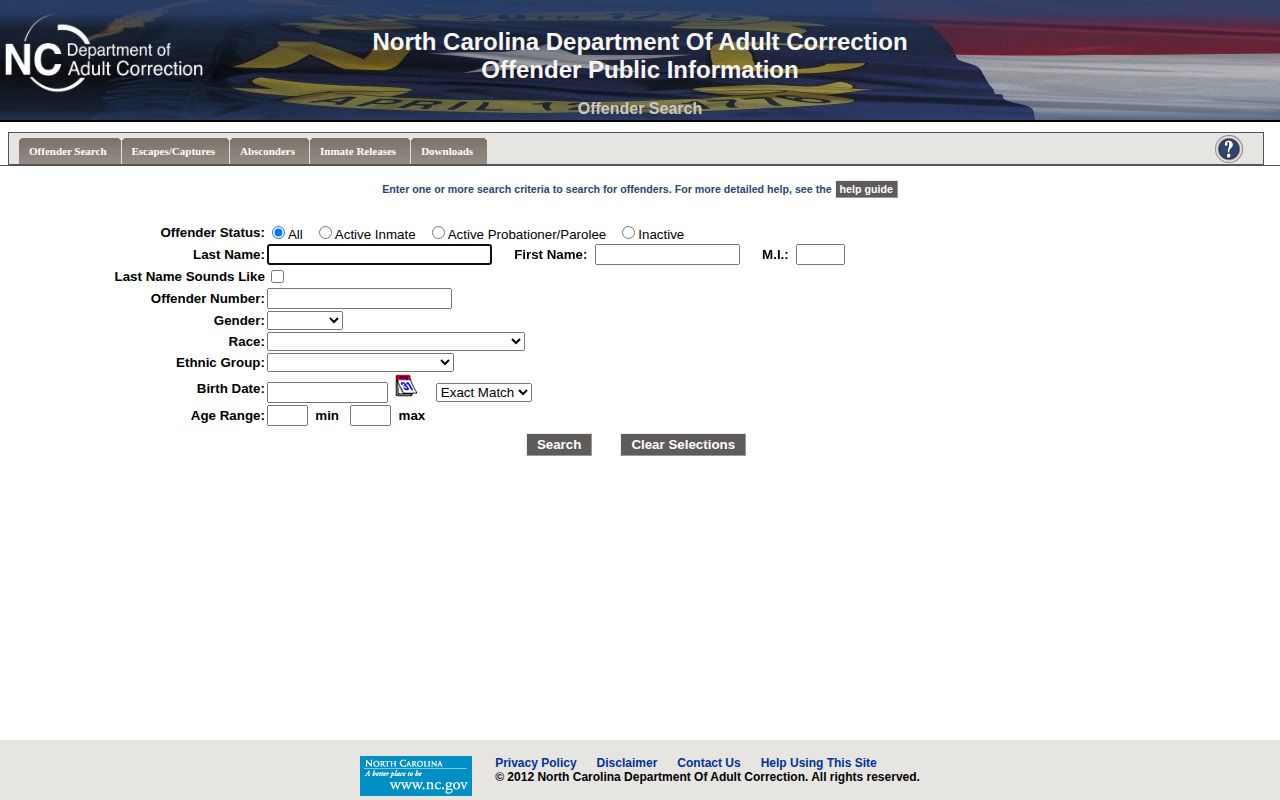
The form's status and identity controls show why the correct record must be opened before reading any projected date.
Note: An Active Probationer or Parolee result means community supervision may continue after confinement has ended.
North Carolina Structured Release Dates
Structured Sentencing generally governs offenses committed on or after October 1, 1994. Under G.S. 15A-1340.13(d), an active felony offender must serve the minimum imposed by the court. Earned time can reduce the maximum toward that minimum, but not below it.
NCDAC describes the framework as 100 percent of the minimum and at least 85 percent of the maximum. That summary is not a flat promise of a 15 percent cut. Credits depend on the sentence and qualifying conduct or activity. The judgment sets the range. Correctional records then apply lawful credits and changes.
- Minimum
- The court-imposed period an active felony offender must serve under the structured rules.
- Maximum
- The upper term used with earned time and the applicable supervision-release point.
- Earned time
- Credit tied to qualifying work or full-time programs, subject to NCDAC rules.
- Discharge
- The end of the sentence, which is different from leaving prison for supervision.
North Carolina law links many prison exits to post-release supervision. Under G.S. 15A-1368.2, the ordinary release point is the maximum less a stated supervision period and earned time. Class B1 through E felonies generally use 12 months. Class F through I felonies generally use nine months. Specified sex-offense maximums use 60 months. The community supervision period remains part of the sentence.
Older Moore Sentence Credit Rules
Fair Sentencing applies to offenses from July 1, 1981 through September 30, 1994. These cases can use older good-time, gain-time, merit-time, and parole rules. NCDAC says gain time may arise from work or programs, while good time may provide one day of credit for each day of good behavior. Discipline can cause forfeiture.
Older parole-eligible sentences also may require action by the North Carolina Post-Release Supervision and Parole Commission. Parole is conditional release under Commission authority. It is not the same as the automatic structured-sentence release point. A projected date for an older case therefore cannot be rebuilt safely from a modern percentage.
The offense date, judgment, sentence type, and credit history all matter. If the online display is unclear, NCDAC Victim Support Services can explain official projected-date terms at 1-866-719-0108. It cannot turn a public estimate into a guaranteed exit.
Why Moore Release Dates Change
A calculation can change while custody continues. Some changes affect credit. Others change the judgment, the controlling agency, or the legal point at which confinement ends.
| Factor | Possible effect | Best confirmation |
|---|---|---|
| Work or full-time program | Qualifying earned time may move a state projection toward the minimum | NCDAC individual record |
| Discipline or assignment loss | Credit may be forfeited, withheld, or later restored | Current NCDAC calculation |
| Resentencing or vacated judgment | The legal sentence basis changes | Court judgment and correctional record |
| New sentence or detainer | Another case or agency may continue custody | Holding and receiving agencies |
| Transfer or program completion | Credit status or custodian may change | Updated agency record |
| Parole action in an eligible case | Commission action may affect conditional release | Commission and NCDAC records |
Legislation and case law can also alter a calculation. For that reason, write down the source and check date. Never subtract a guessed percentage from a maximum term and call the result an official Moore County inmate release date.
Note: A transfer ends custody at one facility but may start or continue custody under another agency.
Moore Jail Credits Are Different
A sentenced misdemeanant held at the Moore County Detention Center follows a local confinement calculation, not the NCDAC prison projection shown for a state prisoner. G.S. 15A-1340.20 says each day of an activated term is served except for authorized credits. NCDAC or the local custodian may award earned time under applicable rules and G.S. 162-60.
The combined credit for a sentenced local misdemeanant cannot exceed four days per month. G.S. 148-13 requires state credit regulations to be distributed to and followed by local jail administrators for sentenced jail prisoners. This rule does not calculate a pretrial bond release, dismissal, transfer, or time-served court outcome.
Moore County has not published an individual credit ledger, local sentence worksheet, weekend or holiday acceleration policy, or fixed release time. Ask for the judgment and jail calculation. Then request the actual entry-and-release summary after departure. That record-specific approach prevents a county date from being copied from a state-prison formula.
Confirm the Moore Release Event
Near the projected date, check the same source again. For a state prisoner, compare the NCDAC record with NC SAVAN, North Carolina's victim notification service. NC SAVAN can report a custody event, but the alert still must be read in the context of the source agency. Release with supervision is not discharge.
The VINELink Release Check explains how to match one person and register for an alert. For a county sentence, call Moore detention and ask whether the calculation changed or another hold remains. Court records may show the legal order, while the detention record establishes when the person physically left.
After the event, ask the Moore County Sheriff's Office for the existing entry-and-release summary. Under North Carolina public-record rules, the agency need not create a new calculation or custom report. A completed record is the soundest way to replace a projection with the actual date, release type, and destination if those fields are recorded and public.