
Moore County 72-Hour Release Reality
No official Moore County page reviewed in the research is labeled as a rolling 72-hour released-inmate list. The Moore detention search includes an “Over the last number of days” input, and entering three may look like an easy answer. Yet the interface is framed around inmates and bookings. Its public grid displays an admit date, not a release date.
The missing feed changes the task. The goal is not to produce a guessed list from names that appear or vanish. Instead, collect release facts for the relevant three-day span from records that identify the booking, actual exit, legal authority, and destination. No official online cadence, three-day display-retention period, or post-release photo window was found.
Note: For the narrowest same-day workflow, use Released Last 24 Hours and verify each event with its source agency.
Rebuild Moore County Three-Day Releases
A three-day reconstruction begins with the last known custodian. For a Moore jail detainee, search the official portal by name to establish current presence and identify the matching booking. If the person is absent or the result is unclear, contact the Moore County Detention Center at 910-947-2980. Ask for the existing entry-and-release summary covering the specific booking and date span.
- Define the start and end of the 72-hour period. Keep the dates clear when the span crosses a weekend or holiday.
- Check the Moore portal for current presence and booking identity. Do not label the results as releases.
- Ask detention for the existing release date, release type, authority, and recorded receiving agency for the named booking.
- Review NC VINELink or an NC SAVAN alert, checking whether Moore County or another custodian supplied the event.
- Match the event to the Moore County court case when a bond order, judgment, dismissal, or sentence may explain the custody change.
- Follow any transfer into NCDAC, another jail, federal custody, or immigration custody through the receiving system.
This process may yield a confirmed release for one person rather than a public list of everyone released. That is the honest result supported by Moore’s available channels. A custody notification supplies an event, a court record supplies legal context, and the jail record supplies the physical exit entry. The sources should agree before the event is described as release to the community.
Moore County 72-Hour Release Fields
Since the county does not expose a 72-hour release table online, the fields below describe what to seek in the existing release record. Ask for records, not for a new custom report. The request can name each person and booking already identified, or it can describe the relevant existing entries for a narrow date period while recognizing that the office need not create data it does not maintain.
| Field | Use in the three-day review |
|---|---|
| Identifying data and booking number | Separates similar names and ties each fact to one custody episode. |
| Admit date and time | Prevents a new booking during the period from being mistaken for a release. |
| Release date and time | Places the recorded Moore County exit inside or outside the 72-hour span. |
| Release type or reason | Shows the recorded basis, such as bond, time served, sentence completion, or transfer. |
| Releasing authority | Connects the jail entry with a court order or other legal authority. |
| Destination or receiving agency | Distinguishes community release from continued custody elsewhere. |
Not every Moore record will contain every desired field. Bond does not mean acquittal. A dismissal in court can explain a case outcome, but the jail still supplies the exit time. “Time served” explains the custodial basis without proving that all supervision ended. A transfer is an exit from Moore County Detention Center and continuing custody at the same time.
The state sheriff records schedule authorizes destruction of inmate incarceration records three years after release or transfer, subject to other holds. Those records include entry and release summaries, arrest sheets, and commitment or release orders. By contrast, a weekly inmate list can be destroyed when superseded or obsolete. Web visibility and record retention are different questions.
Moore County Weekend Release Checks
A 72-hour window is most useful when a single calendar day is too narrow. A Friday court event, a later jail entry, and a weekend custody alert may appear at different times. The research found no Moore County promise about release-processing times, weekend or holiday procedures, physical exit, or update cadence. Those gaps should remain explicit.
Build the sequence from timestamps rather than assuming that each system updates at once. The court docket may show when an order was entered. The detention record may show a later exit. NC SAVAN may deliver a custody-change notice after the source agency submits the event. If a transfer followed, the receiving agency’s record may begin after Moore’s custody entry ended.
- Keep the full three-day date range in every request.
- Record the source agency shown on each alert.
- Separate the court order time from the jail exit time.
- Ask whether a transfer or hold delayed community release.
- Call before an in-person visit because no detention release-desk hours were found.
A longer window improves coverage, but it does not cure weak data. If the only fact is that a name no longer appears online, the release remains unconfirmed. Use the Moore County released-inmate search when the person’s last custodian is unknown and several systems must be checked.
Note: Weekend timing can separate a court action, jail exit, notification, and receiving record even when they concern one custody change.
Moore Portal Is Not Release Feed
Moore’s interface creates a specific risk of mislabeling. Its days field accepts one to four digits, but no official text says the filter means people released during that many days. In addition, JavaScript route strings contain released-mode names. Public testing during the research found those routes redirected to the normal index or current grid rather than a released-person view.
That behavior rules out two shortcuts. Entering three does not create a 72-hour release list, and visiting a route with “released” in its technical name does not prove that the page serves released-person data. The visible columns and official labels control. Moore’s current grid shows full name, age, race, sex, and admit date, while no public release-date column was verified.
Separate Moore County Release Systems
The correct lookup depends on who held the person. A release from Moore County Detention Center belongs in the sheriff’s incarceration record. A North Carolina state prisoner belongs in NCDAC. A federal prisoner belongs in the federal system. Removing a person from Moore custody can also be the first half of a transfer, so both the releasing and receiving records matter.
| Custody path | What the result means | Confirmation source |
|---|---|---|
| Moore jail to community | County custody ended under a recorded local basis. | Moore release entry plus court context. |
| Moore jail to NCDAC | The county hold ended, but state confinement began. | Moore destination and NCDAC admission. |
| NCDAC to Moore release county | A state prisoner’s release record is associated with Moore. | NCDAC state release and offender history. |
| Moore jail to federal or ICE custody | Local custody ended while another custodian took control. | Moore transfer entry and federal locator. |
The NCDAC Inmate Releases form is the real online release feed available for state correctional records. It can filter by release county and month or by name. Moore is available as a release-county choice, but that field is a state release dimension or destination. It is not a list of releases from the Moore jail.
The official state form is shown below. Its Moore option can help with a state prisoner returning to the county while remaining separate from the missing local 72-hour feed.
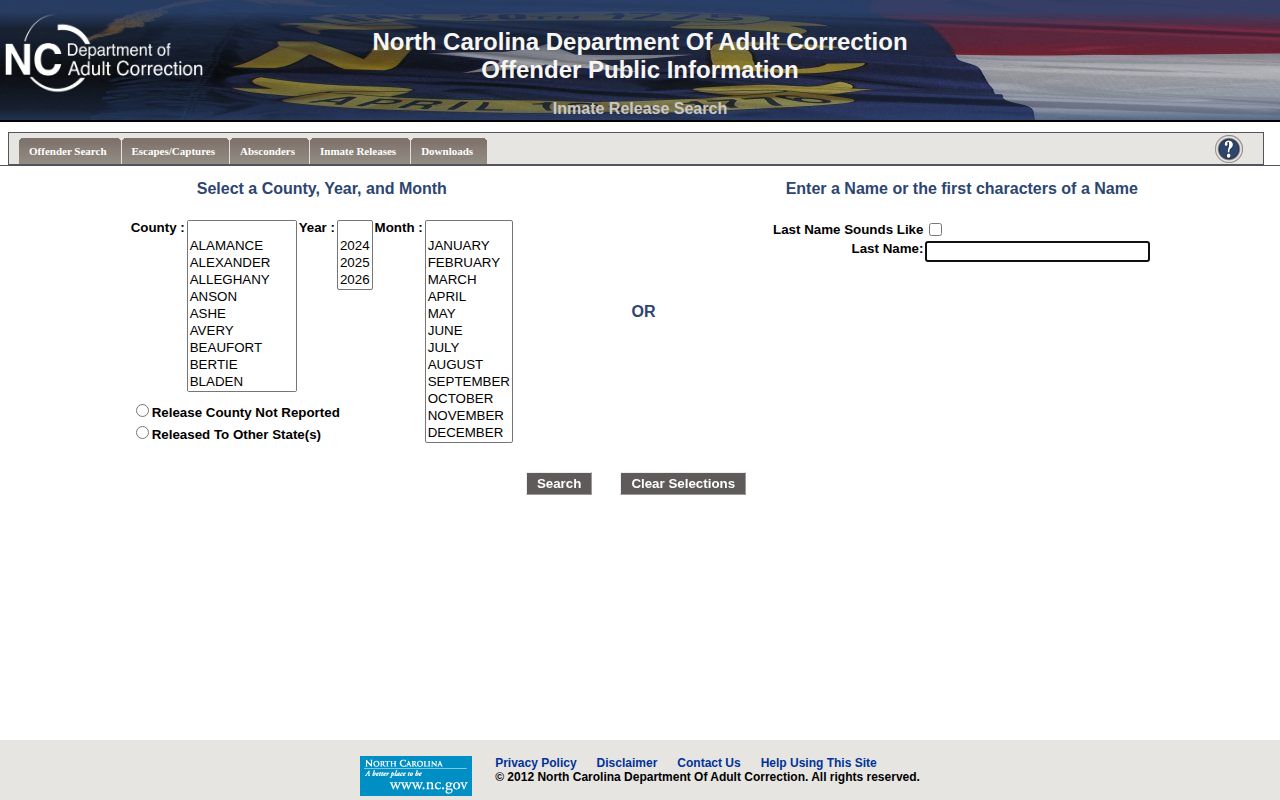
A purely local jail release may never appear in NCDAC. Likewise, an NCDAC record associated with Moore does not show that the Moore Sheriff held or released that person. Read each record as release from that custodian only.
Keep Moore County Release Proof
Once the sources align, retain enough context to understand what was confirmed. Note the person and booking, the custodian, the release date and time as recorded, the release basis, the source of the legal authority, and any destination. Do not reduce that set to a date alone. The same date can describe release on bond, sentence completion, or a transfer into another system.
NC SAVAN and VINELink are useful for custody-change awareness, but the alert is not the full documentary record. Check the displayed event wording and source agency. A county event may be followed by transfer. A state “release with supervision” means confinement ended while legal control continues. An “Inactive” NCDAC record means the person is no longer active in that correctional or supervision system, not that every legal obligation vanished.
For the Moore County record, ask for the existing entry-and-release material soon after the event. Pair it with the court record when the reason needs legal context, and with the receiving system when detention reports a transfer. That approach preserves the distinction a public rolling list would otherwise blur: exit from one jail, release into the community, and full sentence discharge are three different facts.
Note: A three-day reconstruction is complete only when the custodian, event, time, authority, and destination are read together.